
Death & Life Studies and Practical Ethics Lecture Series
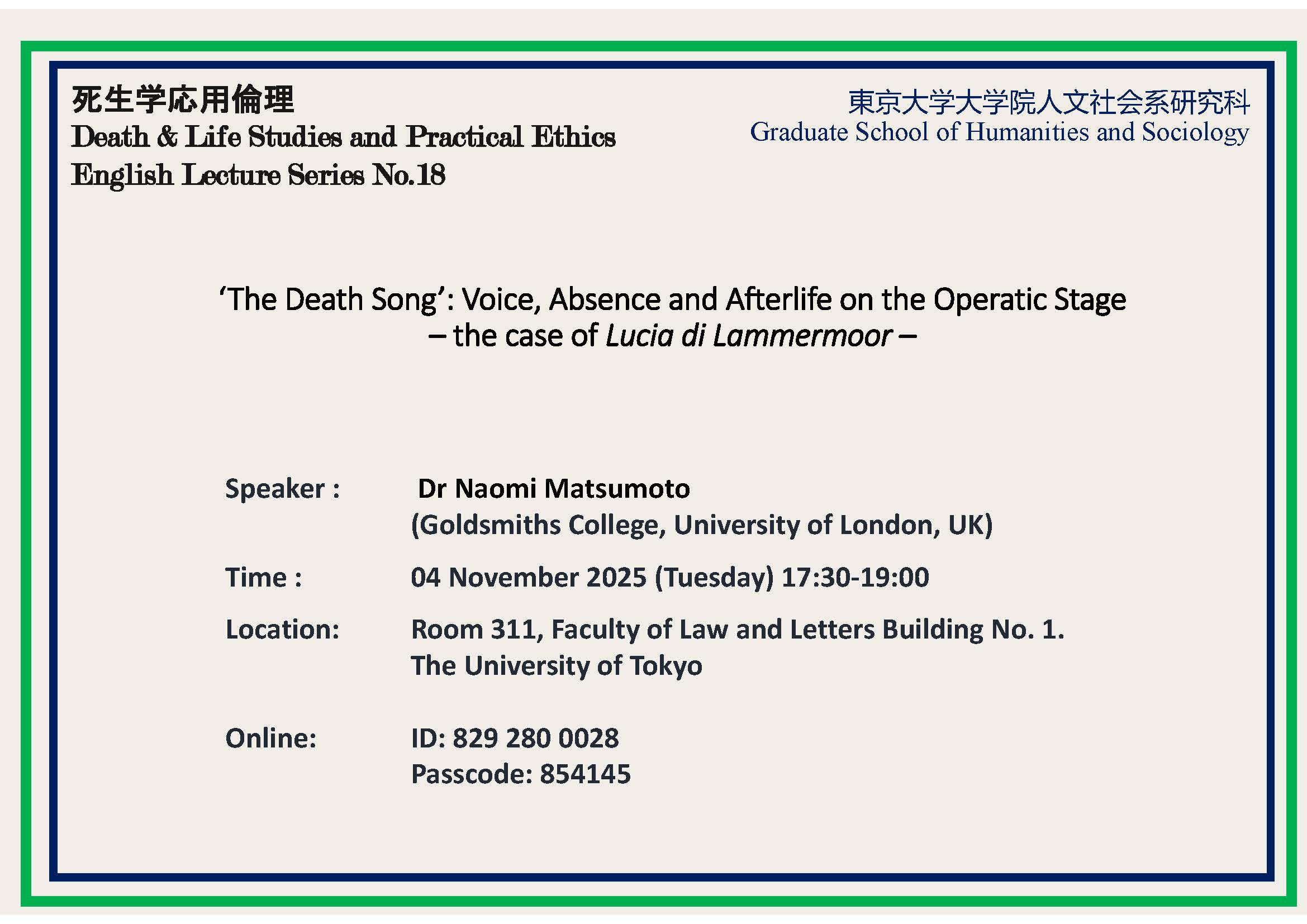
Number 018
Dr Naomi Matsumoto, “‘The Death Song’: Voice, Absence and Afterlife on the Operatic stage – the case of Lucia di Lammermoor –”
【Date and Time】04 November 2025 (Tuesday) 17:30-19:00
【LANGUAGE】English (no interpretation)
【HOW TO PARTICIPATE】
IN-PERSON: Room 311, 1st Floor, Faculty of Law and Letters Building No. 1.
The University of Tokyo
ONLINE ZOOM: ID: 829 280 0028
Passcode: 854145
Host: Department of Death & Life Studies and Practical Ethics
Grant : International Humanities Project, Graduate School of Humanities and Sociology
Joint Host: Graduate School of Humanities and Sociology, and Tokyo College
*This event is part of both "Death & Life Studies and Practical Ethics Lecture Series"
【Speaker】
Dr Naomi Matsumoto
(Goldsmiths College, University of London, UK)
【Abstract】
This presentation explores the representation of death on the operatic stage,
examining how such portrayals reveal broader cultural and aesthetic meanings of
death. While love and death are central topoi in opera, the direct depiction of
death has been notably underexplored in scholarly literature. During the early
years of the genre, Horatian theories of theatre discouraged the explicit
depiction of violent or fatal acts, a constraint that faded by the nineteenth
century. This shift allowed for more overt portrayals of death emerged as
exemplified in works such as Verdi’s La Traviata (1852) and Bizet’s Carmen (1875).
Among these 19th-century works, we will focus especially on Donizetti’s Lucia di
Lammermoor (1835). Following the opera’s iconic ‘mad scene’, the heroine’s
death is announced but never fully explained. This ambiguous death transforms
Lucia’s mad scene into a ‘death song’, a moment where her voice, immortalised,
becomes a haunting echo of her existence, transcending her physical absence.
Through this analysis, the paper explores the nuanced relationship between life
and death on the operatic stage, highlighting the dynamics of presence v.
absence and revealing how the ghostly remnants of a voice in the face of death
offer a potent metaphor for loss and transcendence.